Friday, March 7, 2014

What Has the US Government Done For You Lately?

I just attended a Big Data in Defense and Government Summit in Washington, DC. I blogged about some more technical takeaways that I learned, mostly about the big challenges government agencies face, over on the Actian blog. But one of the most valuable takeaways for me personally wasn’t technical. It was about the power of big data analytics when put to good use, and what my government has done for me, and a whole lot of other folks like me. In particular, the presentation by Xavier Hughes, the Chief Innovation Officer for the Department of Labor really touched me.

He did a very brief presentation, then opened up for questions from the audience. The first question someone asked was, what does a Chief Innovation Officer do? Among other things, Mr. Hughes’ job seems to entail a lot of work toward getting different teams across the government, and the private sector, to work together to accomplish new things. He called it “friendly and productive collaboration.” He put a big emphasis on creating a data-driven culture in every agency he interacted with, working toward making our government procedures more evidence-based, rather than simply continuing to do things the way we’ve been doing them in the past. Some of the things he said should resonate with anyone working to get an innovative new big data analytics project implemented.

“Do not walk in the door and expect people to know what big data means, and what it can do for them. Do not expect technology to solve all your problems. You first have to create a culture that is data-driven and evidence-based.” – Xavier Hughes, CIO, Dept. of Labor

As far as what purpose that new data-driven approach was put to, he talked a lot about finding new ways of helping veterans transition into the civilian workforce, including integrating new data feeds such as Monster and LinkedIN into the current system, and finding new ways to present veterans’ skills so they match up to what businesses are looking for. He also talked about making veterans benefits and such more accessible by giving them one place on the web to start, rather than 25 different portals. All of that sounded very impressive to me.
When it was my turn to ask a question, I asked him what he had done in his tenure that he was most proud of. He said he couldn’t name just one thing, but he could name two.

First, he talked about the executive order from the president to improve customer service and streamline service delivery. He worked with the OMB (Office of Management and Budget), started a pilot program with several other agencies, and piloted a 36 month project to improve customer service across the board in all of those agencies. After a careful study of the current state, he had a CRM solution procured and implemented for capturing customer feedback and consolidating knowledge in a single location. Before, answers to questions were often coming from individual knowledge bases within each individual department or agency. Fifty different knowledge bases was not an effective model. Now, instead of getting confusing mixed messages, the new channel agnostic approach means that, no matter what channel you use to contact the various agencies, you get the same answer to the same questions.

Second, he talked about the equal pay for equal work project. This project pulled in data from outside sources, such as salary.com, as well as sources inside the government. Craig Newmark (famous for CraigsList) helped on that project. The end result of this project is that when a woman enters the workplace, she’s not discriminated against in pay rates right from the beginning.

Wow.

He mentioned being particularly proud of that second one as the child of a single mom. Being, myself, both the child of a single mom and a woman supporting her family in a male dominated field, that one really hit home for me.

I’ve got to say, if you’re a veteran, if any of your family or friends are veterans, if you are a working woman or if any of your family or friends are working women, you owe this man, and all the many folks in the government who have helped his projects happen, a really big “Thank you.”

Like any citizen, there are some times when I don’t agree with or like what my government does. Folks feel free to criticize and to hold our government accountable when that happens very loudly and persistently, and that’s all to the good. But sometimes, we should also take a little time to applaud the things our government has done right.
I made a point to shake Mr. Hughes hand before I left and say, “Thank you for what you’ve done.” And I’d just like to do that again here. Thank you, not just Mr. Hughes who led the charge, but everyone who got on board and pitched in to make his ideas a reality. I know it wasn’t easy, and I’m sure it’s far from perfect, but those are some genuine and much appreciated steps forward.

Sunday, February 2, 2014

Planning my invasion of Mars

So, I want to write a story set on Mars. First, I had to essentially, plan how I would colonize Mars. So here are my rambling Mars colonization notes in case anyone is interested.

Let’s say that the Mars One mission was successful for the first couple of crew missions. I’d say they chose the Terby Crater on the northern edge of the Hellas Planitia Basin, but tech has moved forward since then. In particular genetic engineering takes a few leaps forward with the new gene mapping, data crunching and bio technology available. So, we have a new strategy, a new mission, with a different sort of goal. Long term survival of Earth life on Mars. 

Yes, that was the same goal of Mars One, but I have a different version of long term. Not just the lifetime of the colonists and their children restricted to little habitats and occasional careful trips outside in pressure suits, but actual life adapted to live on Mars as if it belonged there. Even if they lose touch with Earth forever, after a few years to get established, the people on Mars should be able to continue on their own, and thrive, and their children and grandchildren.

First, cyanobacteria are dropped into the Martian atmosphere, in huge quantities by probes, in an effort to do a partial, long term terraforming, just to convert C02 to O2, in order to improve the oxygen content of the air slowly over time. The existing probes should register as the oxygen level rises incrementally, indicating marginal success, and letting us know to go ahead with the next step. 

Cyanobacteria and slightly genetically modified lichens (just to make them grow faster) would be used for oxygen, and food. Habitats built using 3D printing style technology and little AI driven rock tunnelers and general worker bots, with a sort of hive mind. They build like an ant colony, only occasionally needing instruction from the “queen” on earth at mission control. They could all land in a single transport, like a large rover, but they'd be multiple and semi-autonomous, and possibly self-replicating if they can find the materials on Mars to do that, with pre-programmed missions, and the ability to give them new instructions whenever needed, either from Earth, or the colonists themselves.

Maybe a large rock eating machine, or a fair number of them could be created by a combo of 3D printing and parts from earth and worker ants. The machine would crush rock, extract essential minerals, release useful gases, to work on improving warmth and air pressure over time, and provide raw materials for building. That might be a good idea, but I'm not sure how feasible that would be.

The worker ant machines land near the Baetis Mensa in the Ophir Chasma, the northernmost canyon of the Valles Marineras Canyon System, in the lowest spot right near the equator of Mars. The air density in the bottom of the canyon is twice what it is at 0 level, and it actually gets up to a pleasant 70 degrees Farenheit in that part of Mars in the summer, and only down to the equivalent of a cold day in Point Barrow in winter. The bots capture and concentrate solar radiation and solar power to smelt the hematite ore that's all over that valley into steel, and heat the sulfite rocks to release water, and use the sulfur and other native materials to make batteries. The worker ants would create a honeycomb of naturally radiation resistant, airtight caves, with one goal being to seek underground water sources and the other to create living and growing spaces for people and plants. More than just the lichen and bacteria could grow inside the shelters, but only the hardiest high altitude edible plants would make sense. A steel reinforced concrete large scale habitat would be built merging into the side of the cliff, and extending out from it with 3D printing tech and local materials. 

The moment a decent supply of underground water, a major goal of the little ant bots, is located, much of the water is split into O2 and H2 for backup fuel and oxygen.  Most tech is solar powered, with long battery backups, lithium/sulfur batteries made from local materials can be built as needed in large quantities. Supply the lithium from Earth to build a few hundred of those suckers, and hope to find a lithium source by the time you run out. If not, have to have Earth send more with the next mission. Eventually, you gotta find a local source, or modify the way you store power.

Water extracted is stored in multiple redundant areas, as is oxygen and hydrogen separately. The worker ants plant, tend and encourage lichen growth wherever they go. Large sealed tanks of cyanobacteria generate most of the oxygen. Light is brought in for them through a series of reflectors and clear panes.
Caves are completely lined and filled with lichen on any unused surface providing natural oxygen, and food supply. All lighting systems simulate sunlight for the plants, or reflect sunlight in through clear panels, or both. Entire large sections of the caves are specifically for sheltered concentrated growth of the oxygen producing life forms, to produce enough for high altitude adapted humans to live in the habitats.

Entire Valles Marineras would eventually be seeded by the little bots with edible lichen and cyanobacteria, which can absorb water in the early mornings when the ice condenses. A thin roof of solar sheeting stretched across small portions of the valley by the human habitat help concentrate the oxygen and atmosphere as well as collect power. They are designed to stretch, move, flap, and give with the wind, but not tear, and channel dust and debris to hollow iron and concrete poles, which transfer the power down to batteries. Dust storms just make the shelter stronger. Over time, more and more of the valley will get a bit of a blanket roof. Solar sheeting is made from local materials, with only essential rare minerals supplied from earth (not sure how to make this, challenging, but important and doable, I think.) Little worker ant probes or the big rock and dirt eater continually search for Martian sources for all minerals needed.

This is all relatively standard Mars settling kind of strategy. The twist in this is genetically engineered people. There are massive ethical and practical questions that would undoubtedly be part of accomplishing that, but I'm totally going to bypass those (coward, I know,) and assume they got slugged out over the next two decades. First mission in 2033, second in 2035, third in 2037. Six pregnant women and two men on every mission.The people are all chosen for genetic diversity and high altitude adaptability, as well as the usual expertise and physical health criteria. The children are genetically modified embyos. By the time the third mission lands, the six first mission children would be school age.

The genetic fathers of the children were sperm donors from Peru, Tibet, Nepal, and other high, cold places of earth, the Andes Mountains, the Kunlun, the Himalayas, the Hindu Kush, the Tian Shan, the Karakoram, the Pamir, the Saint Elias, and the Caucasus. The men who travel with them are of the same high altitude, cold and thin air tolerant genetic stock. The transport ships and Mars habitats themselves have atmospheric pressure roughly equivalent to 3 miles high on earth, like a Peruvian or Tibetan village. The men are there to help when all the women are very pregnant or nursing tiny infants, and on the assumption that more children will follow after they land, through natural means and slight modifications of the embryos conceived so that they match the new Martian children. At least one gifted genetic engineer would travel with each mission.

The children would be modified as little as possible, but the minor modifications produce huge differences in physiology. Their lung capacity, already the best humanity has to offer, would be expanded to four times any earth human’s, and production of hemoglobin proportionately accelerated to allow maximum absorption of available oxygen from thin atmospheres, along with extensive capillary systems, and rapid respiration rates, a high tolerance for carbon dioxide, and blood pressure that is far below dangerous levels for a human, low enough to balance against a far lower air pressure externally. 

Their skin would be the only obvious external difference; hair follicles modified to produce scales which provide double the protection from exposure to radiation, help with the low air pressure, plus they would seal in water to minimize dehydration. A layer of fat just under the skin insulates them from the cold (about double the thickness of the average Eskimo) and also makes them less susceptible to radiation. One last important modification would be a nictitating membrane to protect their eyes from the thin, cold atmosphere, dehydration and dust.

Special community nursery rooms for the babies would have been built on the outer edges of the colony habitat. The lichen grow in them and oxygen is supplemented, but the rooms are not pressurized. Mothers must put on pressurized suits and pass through airlocks to tend to their littles. The babies have to be born in specially prepared rooms. One or two moms stay with the kids awake at all times in case the kids need anything, since it would take too long to get to them through the airlock in an emergency. All the moms take turns.

Similarly genetically modified pregnant Peruvian chinchillas travel with them. Their babies thrive on a diet of lichen and require very little air. Their flesh provides much needed protein and their skins and fur provide warmly insulated clothing for the growing children.

The chinchillas and the children alike need only a bit of extra oxygen to survive comfortably in Martian air at the bottom of a chasma. Large outdoor structures are built that hold in some of the extra oxygen the lichen and algae provide, concentrating it on the valley floor, so, after a few years, the children and critters can roam around outside a bit. They should bring oxygen with them, just in case.

As the bacteria seeded in the atmosphere continues to build the oxygen levels globally, the children will need less and less supplemental oxygen and be able to roam further from the habitats safely. They won't be able to climb the walls of the chasm, though, because the air at the top is half the air pressure of what's on the bottom. Fortunately, that chasma is hundreds of miles long, giving them lots of room to expand over time. The earth humans will always be confined to the habitats or pressurized suits, but their descendants will be adapted to large sections of their new world. With a pressurized transport vehicle, they could travel to the other large depressions on the Mars surface several generations down the road when they feel the need for more space.

Now, a lot of folks, who are into this sort of thing, are probably wondering why I didn't think of heating the polar ice caps, particularly the southern one. Currently, we could heat the southern polar ice caps of Mars with reflective mirrors and produce a thicker atmosphere that would warm the planet and increase the water content of the air. However, we cannot currently simulate the magnetic field of a planet that holds that air in. Heating the solar ice caps to terraform Mars would only accelerate the loss of the last remaining free C02 and water on that planet, leaving our new race of people stuck on a dying planet.


When we gain the knowledge needed to give Mars a magnetic field, or learn some other way to hold the air in all over the planet, the children of Mars, who were otherwise restricted to just the deep valleys where the air pressure is twice that of the neutral surface, will be delighted to have the highlands opened up to them, vastly expanding the area of the planet that they can comfortably live in, and the earth humans can move into the valleys and lowlands where the air will be dense and oxygen rich enough for the most high altitude adaptable of them.

Instead of forcing Mars to adapt to become completely Earth-like, we would adapt the planet a little, and adapt ourselves a little, and meet in the middle.

That's how I would do it anyway,

Paige

Saturday, January 25, 2014

Blacksad in French and Having Kevin Grevioux's Babies

I mentioned the mind meld over on SFSignal where several talented folks and I picked our favorite graphic novels to take to a deserted island. (I just did a quick scan of mine, btw, and discovered at least once that I wrote "dessert" island, which wouldn't be very lonely probably, but would be HELL on my waistline.) Sarah Arnold recommended "Blacksad" and I remembered how much I adored the art in the issue I had glimpsed years before. The story was as gritty and dark as anything written by Dashiell Hammett, and I didn't need to be able to read Italian to tell that. The art, complete with a hyper-realistic world filled with talking animals, and dusky, muted colors that enhance the emotional impact of every panel, flat blew me away.

I have been, in my copious free time (that's extreme sarcasm for anyone who doesn't know me personally), learning French, with a combination of Rosetta Stone and reading French fiction, with the aid of Google Translate to help me through the difficult parts. I got a book of French dialogue for Christmas that was greatly appreciated. I pretty much suck at holding a conversation, but I'm getting pretty good at reading comprehension in French. Add illustrations or a contextual story I'm really familiar with, and I'm golden. The difficulty has been mainly finding fiction in French that I actually want to read.

So, I bought "Blacksad" the Kindle edition, to save a little money, and splurged on a difficult-to-find used copy of vol 1 in French. The Kindle edition arrived immediately, but wouldn't run on my Kindle Fire, which I have to say was very disappointing. The main reason I bought a Kindle Fire was to read comics. Fortunately, I have an IPAD for work, and the graphic novel reading app works fine there.

They just delivered my French vol 1 of Blacksad!! It is just as gorgeous as I remembered. The Kindle version is great, but there's nothing like holding the book and seeing the art full size. It's as moving and solid as a kick to the gut.

Don't get me wrong. Kindles are nice, and have performed a bit of a miracle for me. I haven't bought episodic comics in years because I would read them in like 5 minutes flat, and they cost almost as much as a novel. I just couldn't justify the expense. I grew up poor as dirt. That still affects my buying patterns significantly, regardless of my current income bracket. Now, I'm reading "Anathema" (which is a dark horror comic I'm loving, even if it is a bit preachy) and waiting eagerly for the next issue. I've also started snagging issues of Dr Who comics and whatever else grabs my eye on Comixology. At $1.99, I'm far less hesitant to splurge, and I can take a big chunk of my comics collection with me on planes and such now.

On the subject of brilliant graphic novels, not the price of them, I went and saw the movie "I, Frankenstein" last night. Wow. Just visually extraordinary. And unlike a fair number of visually stunning movies I've seen lately, this one had emotional impact and great acting, and just wow. It was a bit short on sophisticated plot, but hey, demon prince wants to take over the world, order of holy do-gooders want to stop him, and hapless anti-hero is caught in the middle - it works for me. Add stunning visuals of winged battles between light and fire, and I'm all over that. And Kevin Grevioux wrote it.

It took 2 words off camera for me to recognize Kevin Grevioux's voice, and I knew I was in for a ride. I LOVED Underworld, the first one at least. It leapt a few sharks by the end of the franchise, but had a great starting point. I'd never heard of the "I, Frankenstein" graphic novel, but as I was sitting there, thinking wow a lot at the end of the movie, I remarked to my husband, "This movie looks like it would make one hell of a graphic novel. It looks like it was MEANT to be a graphic novel." At which point, the credits helpfully popped up "Based on the graphic novel by Kevin Grevioux" and I said, "Well, there ya go."

Kevin Grevioux. What is with this guy? Did he win the genetics lottery or something? He's huge, powerful, has a voice like a dragon in a well, AND he's insane levels of intelligent and creative, so he apparently hogged all the good genes for an entire small town. Genetics like that need to be spread throughout the human population. Someone should have his babies. Lots of them.

Not that I'm volunteering or anything. Much. But someone should.

Paige


Wednesday, January 22, 2014

SFSignal and PaigeEwing.com on a Deserted Island with Drugs

Three wonderful things happened to me today that I am selfishly delighted about:

1. SfSignal and Rick Klaw published my list of graphic novels I'd have to take to a deserted island: http://www.sfsignal.com/archives/2014/01/mind-meld-our-desert-island-graphic-novel-picks-part-1/   (Paul Benjamin and Alan J. Porter also put in their lists. Interestingly enough, my list included one of Paul's books, and Alan's list included my number one pick "Strangers in Paradise" plus "Kingdom Come" which I would have added, but wasn't sure if it was kosher under the rules.)

2. Having my personal author website link on said article provided the kick in the pants needed for me to complete at least a first shot at my personal author website www.paigeewing.com Finally! Next, I will tackle that hideous monstrosity I foisted onto caughtdreamsbooks.com. Soon, it too, will look like a normal web page. I promise.

3. I had my 6 week post-op checkup for my herniated disk surgery, and the doc took me off most of the mind and body affecting chemicals. I am very much delighted to have most of my brain chemistry be provided by mother nature again, not a collection of pill bottles.

It's a good day for team Paige.

Thursday, January 9, 2014

ALL comics are fantasy - Or Rant, The Sequel

So, the guy on my list comes back with, "ALL comics are fantasy." (To be fair, he does admit a certain ignorance of the medium, and asks if there are any hard sci fi manga or comics, so, here we go.)
(And as a corollary that at least some folks might agree with, he also added that any story with faster than light travel is as much fantasy as if you waved a magic wand to travel. I'll address that one in a postscript)

Gaahhhhh!!! So, now ALL comics are fantasy!! Really?? So, you’ve read them all, have you?

I’m sure the concept that all graphic stories are fantasy will come as a huge shock to the school librarians who stock history books in graphic form, or the writer and illustrator of the gorgeous line of noir mysteries I was reading. I’ve seen graphic westerns, manga instructional how-to manuals, chic lit in comic form, teen angst stories about making the team and having a zit on picture day. I’ve even seen technical documentation done as a comic book.

Comics are a medium, not a genre!!

To quote an outstanding artist friend of mine, Yehoshua Reyez (http://reyezart.tumblr.com/) to say science fiction can only be written in prose and not in comics or manga, “It's like saying a still life could only be painted in oils, but not acrylics.” It’s ridiculous.

I don’t care where you draw your personal line on what is and what isn’t science fiction, the medium is irrelevant. Only the story counts when determining genre.

Does Isaac Asimov’s work qualify as sci fi?
Like, say, his Robot stories?

Or, the Foundation books?

Or, 2001: A Space Odyssey


How about Phillip K. Dick?
Is “The Electric Ant” science fiction enough for you?

How about “Do Androids Dream of Electric Sheep?”

Or, “A Scanner Darkly”

How about Larry Niven? Does he write science fiction?
Part one of his “Ringworld” series of graphic novels will be out soon:

And those are just graphic translations of some classic sci fi authors. There’s a ton of them, from Asimov to Zelazny, from Jules Verne’s century old sci fi classics to John Scalzi’s work last year.

Then there’s guys like Alan Moore who create brilliant dystopian near future, hard sci fi stories like “V for Vendetta” directly in the comic medium, because they PREFER it.

To dismiss an entire brilliant medium for story-telling simply because all YOU have ever read in that medium is fantasy is very silly. If all I had ever read was Twilight books, I would certainly hope that I would have more sense than to say, “All novels are clearly just about silly adolescent romantic fantasy and vampires that sparkle.”

At least, I hope I would have more sense than to say something like that on a list full of authors.

Stories that speculate about what might happen when science progresses past its current point is MY definition of science fiction. Whether those stories are written in fingerpaint on the side of a building, created on a not-yet-invented 4 D holographic imager, or told in interpretive dance on a stage is utterly irrelevant.

Only the content matters.

Paige


PS. FTL travel is not only possible, it happens on a regular basis on a subatomic level. Making it practical for humans is not possible at this time, but neither was travel by submarine considered scientifically possible or practical in Jules Verne’s day. To limit a sci fi writer, not only to only one medium, but also to only things that are scientifically possible NOW, is to cripple the genius of sci fi writers everywhere, not to mention to slow down the progress of science. If no one ever imagined communication satellites and put them in a sci fi story, would they now be a fact of life?

Several scientific theories exist as to how faster than light travel might be made practical in the future when our technology progresses. Here’s one, for example, which, while at first deemed silly and impossible, then caught on in the imaginations of scientists because of that silly space western (not sci fi of course, by your definition, despite being written by people with no sci fi chops like Larry Niven, Robert Bloch and Harlan Ellison) where that scientist and a lot of the rest of us first saw crazy, scientifically impossible concepts like hand held communicators and tablet computers: http://www.nbcnews.com/id/49064028/ns/technology_and_science-space/t/scientists-say-warp-drive-may-be-more-feasible-thought/

So, right now, a scientist is beginning to see that FTL travel with warp technology might actually be possible. Kind of like, not too long ago, someone imagined that it might actually be possible to split an atom. Crazy concept. Insane. Impractical.

It wouldn’t be science fiction then to write a story about someone who used that “warp drive” technology to travel through space back in the 1960s, but now it would be. By those rules, writing a story about an atomic bomb would have been pure fantasy, if it was written in 1910, but would have been science fiction if written in 1920. And Jules Verne never wrote a science fiction story in his life, of course, since none of the technology he imagined was considered possible when he wrote about it, even though most of it now exists.

In 1870, Jules Verne wrote 20,000 Leagues Under the Sea. In 1876, someone built the first functional model of a submarine. At least in part, the submarine exists BECAUSE Jules Verne imagined it.

Human imagination is where technological advancement comes from. Yes, scientists and engineers have to make it real. But first, someone has to imagine the possibility.


If you limit the imagination of science fiction writers to only what is currently believed possible, then you put one heck of a big stumbling block in the way of technological progress, not to mention good storytelling.

In any medium.

Wednesday, January 8, 2014

"I don't consider manga or comics to be Sci-Fi"

So, a friend of mine, who happens to be an excellent sci fi writer, but who I will not name so that he doesn't get hate mail from all of my friends who write for comics and manga, made this comment in a recent email to a sci fi and fantasy writer's list I'm on.

"I don't consider manga or comics to be Sci-Fi"

This pushed almost as many of my buttons as the recent comments about how "women are destroying science fiction" that have been going around. (Go to LightspeedMagazine.com to see my favorite answer to that one.) Here is my answer:

Ack!! Sorry, but you just hit one of my big pet peeves.

<rant> That’s like saying, I don’t consider movies or TV to be sci fi.  I think this is because you are confusing the media with the message. Manga and comics are nothing in the world but another way to tell stories, a way that intermingles art with literature, and uses both to tell the story.

I have read comics about the problems in a lesbian relationship where one woman is sure that she’s straight and the other is an ex-prostitute with mafia connections, a great manga series about a high school for demi-gods, a comic series about a future city where evolved apes and humans co-exist, blood and thunder fantasy with Conan and Red Sonja slugging it out, an alternate past story where dragons and bi-planes regularly do battle, and a noir story about a grizzled private detective who works in a trans-dimensional city. 

That, of course, on top of a hundred different superhero stories, some set in the past, some in an altered version of the present and some in the future, some in an alternate future where a chemical reaction or DNA splicing virus has escaped into the population causing massive mutations, many awful or deadly, but some extraordinary. I’ve also seen stories set on earth, on other planets, or in space involving galaxy-spanning alien empires.

Any genre of story can be told in comic format. Some individual stories lend themselves more to visual media, some not so much. But the format is just that, a format for story-telling. 2001: A Space Odyssey would have been awesome as a graphic novel. I’d love to see someone do Asimov’s Caves of Steel, Robots of Dawn, The Naked Sun as a graphic series. Ringworld would make a great graphic novel. I could totally see Heinlein’s Friday or Stranger in a Strange Land as a manga.

For a few examples, try this list on Goodreads of 100 great sci fi and fantasy graphic novels: https://www.goodreads.com/list/show/19777.Best_Science_Fiction_Graphic_Novels_Comics

You can argue all day about what is or isn’t sci fi. Everyone has their own opinion about whether space opera counts, or if anything with faster than light travel is “real” sci fi, or whatever. But whether comics or manga qualify as sci fi shouldn’t even be a debate. Sci fi is not about whether the concepts are presented as words in a book, or images with word balloons, or moving images on a screen. The genre definition has to be about “what” concepts are presented, not “how” they are presented.

</end rant>


Paige

Thursday, September 5, 2013

The Magnificent Madness that was Worldcon 2013

So, I went to this little event called World Science Fiction Convention, aka Lone Star Con, since it was in San Antonio, Texas this year. Next year, it’ll be in London and they’ll call it LonCon.  I got to not only go, I got invited to speak on several panels!  I shared panel space with folks like David Brin, had breakfast with Harry Turtledove and Ed Lerner (during which I tried and failed to remember Larry Niven’s name. D’oh!), tea with Lois McMaster Bujold, sat at an autograph table next to Campbell Award nominee Max Gladstone.  This was my first Worldcon. It was a heck of a way to start, I gotta say.

You’ll have to forgive that this is going to be a really long, rambling, seemingly pointless post. My main goal is to remember as much of the event as possible, and to get all this madness out of my brain so I can sleep again. I developed such a tremendous case of emotional and brain overload over the course of the 5 day con that I had a curious block about remembering anyone’s name, even my own once or twice. I called old friends by the wrong name, forgot famous authors that I’ve had engraved in my brain since childhood, and couldn’t remember the name of the chimp who learned sign language. (Washoe, btw.)

On the plus side, I brought a whole bunch of copies of “TheProtectors” with me to the con, and none home. I gave a couple to contributors who I had missed, and a couple to folks who expressed interest in writing for the next anthology, and the rest sold. Woo hoo! I only sold a couple copies of Damson Dragon, though. I blame Denis Loubet for making such an awesome cover for “The Protectors” that no one could resist them.

I saw Denis at the con, for about 2 seconds. Lots of folks I knew there I saw just long enough for zoom-by huggings, and never saw again. Some folks I know were there, and I never even laid eyes on them. The place was massively spread out. According to a pedometer app, I walked well over 20 miles in the 5 days of the con. I did manage to spend a little time with other Protectors contributors: Marshall Maresca, Beth Loubet, Alan J. Porter, Paul Benjamin, K.G. Jewell, and Rick Klaw, who got a quick hug, but I barely saw after that. His new anthology, “RayGuns Over Texas” got a very warm reception, I hear, but I was always on the wrong end of the con when the readings and such were happening.

The river walk between the hotel and the convention center was lovely, although blocked for a mariachi band filming. There was actually 2 conventions happening this weekend in the same building. The other was the People in Hispaniola festival, where my friend Jericho did some crowd yoga presentations while we were geeking out over sci fi.

First thing I saw when I walked in the convention hall front door on Thurs afternoon was GeorgeR.R. Martin chit-chatting with some fans in the lobby. Seemed like a pretty good launching point. I found a comfy spot and went through the program to circle stuff I wanted to go to, most of which I didn’t make it to, ironically enough.

My first panel was an amusing one. I made the mistake of mentioning in my panel survey that I had more costumes than clothes in my closet and ended up on three different costume panels, this one being the most wildly inappropriate.  “Organizing Your Costume Space” Those who know me realize that this is like putting Pig Pen on a panel about daily hygiene. I managed to convince Pierreand Sandy Pettinger to join this panel, along with the other two. Susan Di Guardiola and David Weingart did admirably, with Susan as the shining example of what to do, and me as the horrible warning of what NOT to do.

A chat in the bar with Marshall Maresca and his brilliant son Nicholas was a highlight of the evening.

On Friday, I got a late start, and did a lot of wandering, trying to find the right building, much less the right room, but eventually, found my way to the kaffeeklatsch with ChuckWendig. Brilliant writer, Campbell nominee, and very pleasant fellow. He was kind enough to let me join, even though my misguided wandering had me sliding in way late. His Terrible Minds blog is well worth following, and I’ve been following it for years. There was a challenge to come up with profane new words, but with entries of the likes of “Cuntsnickers” I felt a bit shy about even putting a hat in the ring.

I did a quick turn around the dealer’s room, and Book Universe and LarrySmith Bookseller both put “The Protectors” and the first DamsonDragon novel out on the table. I picked up David Brin’s “Existence” while I was there. 

Over the course of 5 days, with me trying VERY HARD not to buy books, I came home with:
“Existence” by David Brin
“Fleet of Worlds” by Larry Niven and Edward M. Lerner
“Goblinopolis” by Robert G. Ferrell ( Who has been a friend for more than a decade and I didn’t even know he’d written a book, until I stumbled on his booth in the back of the dealer’s room.)
“A Soldier’s Duty” by Jean Johnson
“GreatShadow” by James Maxey
“The Dirty Streets of Heaven” by Tad Williams

My Joe griped profusely, even with this small list of purchases, as he had volunteered to carry them for me across much of the vast distances of the con.

My late start Friday was largely due to a distinct lack of sleep Thursday night, and knowing I’d be up until all hours for the next 2 days, I wussed out on the afternoon and grabbed a nap, emerging in time to make it to my next panel: DC’s New 52: Brilliance or Disastrous? I was the token woman on the panel. I love comics and superheroes, but being on a panel with Jess Nevins, Tom Galloway, and Weldon Adams put me at a bit of a disadvantage. I’m not sure it mattered. I know a lot about marketing, and we mainly discussed what a marketing disaster the New 52 had been. The only genuinely positive comment came from me, “I love Batwoman.” And that was pretty much responded to with, “Yeah, but it was awesome before the New 52.”  I have to add that today, (less than a week later) I have felt immense amounts of sadness and frustration with DC, as they put a big splotch of mud on that one bright spot. This post could have been written by me, it expresses my feelings so exactly: http://virginiagentlenerd.tumblr.com/post/60363186701/batwoman-dc-me

To hear one of the panelists basically say that right now, all the creators at DC would love to work somewhere else, really put things in perspective. Who doesn’t dream about working at DC or Marvel when they’re a kid? How bad does it have to be to chase people with those dreams, and impressively high paychecks away?

And let’s not talk about what they’ve done to Wonder Woman, and not done. I want my damn Wonder Woman movie, and/or a decent TV series.

The next panel was the Writing Erotica panel, which was remarkably civilized, sensible, and even useful, I think, to folks who want to get published in that field. I’ve been on a lot of Erotica panels before, and they tend to degenerate rapidly into silliness, so this was a refreshing change. The other panelists were MaryAnne Mohanraj, Jean Johnson, and one other lady whose name I have forgotten who took Catharine Asaro’s place at the last minute.

I made the rounds of the parties after that, starting at the Space Squid party, so I could say hi and distribute hugs to Matthew Bey and David Chang. I ran into Elle Van Hensbergen at some other point in the Worldcon madness, but I couldn’t tell you when. Might have been at the Space Squid party. NickyDraden was there, too, but pretty much I just said hi. I didn’t get a chance to actually talk to her. I’ve met all of these folks, and half the Protectors contributors, from my critique group, the Slug Tribe, which has churned out amazing authors like Jay Lake for over  20 years.

One interesting person I chatted with for a while was Anthony Tollin, a DC legend. Fascinating source of genre history. Very much enjoyed the chat, and swung by his booth at the dealer’s room a day or two later, to peek at his Shadow and Doc Savage books and memorabilia. He was wearing an outstandingly cool Capt America shirt which I complimented him on, and he said I could get one at Dragon’s Lair. I will have to see if they still have any in stock.

Saturday morning started with me sitting at an autograph table. Beside me sat Max Gladstone, very nice person. He didn’t have a copy of his book with him, or I would have come home with one more book. I’ll have to find it on Amazon. I sold a copy or two of my books, and actually gave out an autograph or two, but mostly Max and I chatted. Also, Connie Willis swung by and spent some time talking to us both. She gave a wonderfully sweet pep talk on being where we were, but with already famous authors sitting beside her with long lines of people waiting for a signature. She even mentioned that a few years back, she’d seen George R.R. Martin being the one with no one waiting while David Brin had a line out the door. I have to say that is one very big-hearted lady to take the time to do that for a couple of brand new writers.

The folks from Larry Smith Bookseller swung by looking for Patrice Sarath to sign a few of her books, and I sent her their way when she came by to chat.

Fully functional Dalek at Worldcon 2013I grabbed some lunch and spent some time chit-chatting with various folks and exploring the dealer’s room a bit. The Dr Who exhibit totally blew me away, fully functional dalek, and K-9. The inventor played with kids as they went by, using remote control, so they didn’t see him. I don’t remember his name, but I chatted with the gentleman for quite a while about how he had built the dalek from a motorized wheelchair base, and where the parts came from and such. Very cool dude.
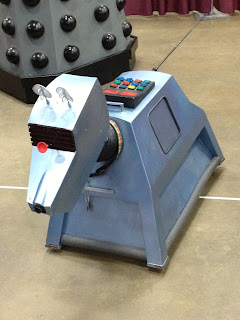
K-9 at Worldcon 2013At some point, I hear, as he was wandering around the con, George R.R. Martin took him on with one of my friend Iolo’s ray guns. That would have been a priceless image. I wonder who won.


Doctor Paige at Worldcon 2013The star attraction of the exhibit, though, was the actual console set from the 1996 Paul McGann 8th Doctor movie. It was gorgeous. I had a panel later with PaulJ. Salamoff, and discovered that it belonged to him. He was gracious enough to grab a few pics of me with the console and the 8th Doctor’s actual sonic screwdriver. He had a 10th Doctor style screwdriver programmed as a remote for the console, so it actually controlled the blinky lights and such. It was the ultimate in Whovian geeky cool. My inner fangirl was squee’ing all over the place.
The next panel I was on was made for photo ops. Steven Gould, Wesley Chu and Paul Benjamin all volunteered to try to reproduce some of the insane poses that they put women in on the covers of comics and fantasy novels. We reproduced some of the ones that Jim C. Hines put in his blog. I got volunteered to help pose folks, but I mostly hauled chairs around and kept Wesley Chu from falling while attempting some of the crazier poses. He had a lot of guts, and even attempted one flying, balanced on the knuckle insane one after everybody left that I was afraid he might break his neck trying. I mistook him for the dude who played the sexy stunt man in The Guild, probably because he said he’d done some stunt work, but he said it wasn’t him. Mary Robinette Kowal turned the tables a bit and imitated a nutty pose that some artist put a man in on the cover of a spy novel.
Here’s a few of the gems from that panel. The right one is from Mr. Eric Ray at http://imgur.com/tLLMOv9:


Steven Gould, Paul Benjamin, Wesley Chu at Worldcon 2013
There was an actual back doctor in attendance, just in case we injured ourselves, I think.

Steven Gould Posing with Paige E. Ewing at Worldcon


More parties Saturday night. Whee. I’m not entirely sure how conscious I was for most of them.

And then, Sunday morning, I had to elucidate the nature of BigData, Big Brother and such. I’ve already given a pretty good summary of the kind of things we discussed on my previous post. It was a really good, thoughtful panel. Ran into friends, Jim Gould (aka Dammit Jim) and Jeff Johanigman from http://www.scareforacure.org/. Oh, for anyone reading this who saw the panel, I gave the website http://www.kaggle.com/ as a good source of big data related stuff and things. I was really trying to think of http://www.kdnuggets.com/ but my lack of memory for names messed with me just then. They’re both good, but KDNuggets really is a gold mine.

I didn’t have much time to chat with folks after the panel. I ran straight to “Body Shaping and Support” the one costume panel that I had real stuff to contribute to. Me and the Pettingers talked corsets, hoops, wings, extra limbs, missing limbs, stilts, arm extensions, heads from helmets, and the lightweight structural joy that is chicken wire. We covered bent leg stilts for werewolves and demons, panniers for French ladies, giant heads and hats with lighted Christmas trees made on bicycle helmets, giant mutant snakes and spiders, and harps that come to life. I saw a couple tweets later from the handle @BorgFest related to our panel, so it seemed to go over well:
@BorgFest: @PaigeEwing & Pettingers answer best question asked @LoneStarCon: how do you attach limbs you weren't born with?
@BorgFest: @PaigeEwing @LoneStarCon And the best follow-up question: how to make one of your limbs disappear? #cyborg #costuming

If you love this sort of thing and live in the Austin, TX area, please, show up at Scare for aCure. They will scratch your freaky costume itch between cons. Oh, and tickets for this year are on sale. Get them before they sell out. They always do.

Sunday was a crazy busy day for me. I had four panels, and then the Hugos.

My third panel was an important one, “Who’s Working on Gay Issues and Themes in SF/F?” That was the one panel I would not have missed for anything. We all agreed that Doctor Who is getting it right. Some folks from the audience pointed out that some authors have been doing it right for a long time, and gave Marion Zimmer Bradley’s Darkover novels and Mercedes Lackey’s Vanyel stories (The Last Herald-Mage Trilogy) as excellent examples. Ursula Le Guin didn’t get mentioned, but she should have. Lots of good historical examples, and some great current examples were sitting on the panel with me. My Iron Angel in the “The Protectors” books is a gender queer hero and Remedy is her bi partner. Matthew Johnson’s “Fall From Earth.” PaulJ Salamoff’s “Discord” has a hero made of 6 people, one a lesbian woman very gently handled. Lee Martindale is famous for off-beat heroines that don’t fit any standard mold. Scot Bobo and Julia Rios rounded things out. I believe Julia, who does the Outer AlliancePodcast intends to broadcast the panel some time soon. I’ll keep an eye out and see if I can update this post with a link when it goes on line.

My fourth panel was “First Contact Without a Universal Translator.” I was really looking forward to a good discussion, but it didn’t go very well. The panel drifted off topic a fair amount. We did get in a little talk about chimps and gorillas who have learned sign language, and IQ tests that are species skewed. I didn’t get a chance to mention it, but had heard a lady was doing some experiments with dolphins where she blindfolded herself, and sort of forced the dolphins to talk to her. It was the only one I know of where we were trying to get the higher order intelligence animals to communicate with us and understand them, rather than simply forcing them to learn how to understand what we tell them to do. One of the people in the audience contacted me later on email, and said he really enjoyed what I had to say, so I guess it wasn’t a complete waste. My one valid point, aside from the fact that it’s not a black box problem, we have alien intelligences here on earth we should be practicing on, was that if aliens manage to cross interstellar space, having conquered the limits of Einsteinian physics, and the challenges of living in space, and probably visited other worlds, I would hope that they are up to the challenge of communicating with us.

Right after the con, I saw this, and realized how far we are from ever truly communicating with any alien species, when wecan’t even understand our own genius children. The state of cognitive psychology is so primitive that we can’t tell the difference between a severely damaged mind and an extraordinarily gifted one. If you watch the kid’s Ted Talk, he demonstrates a form of mathematics that doesn’t use numbers. One of the basic tenets the panel tried to establish was that math and numbers would be a common element between us and alien species. I think the kid pretty much blew that theory out of the water.

After that, I zipped to the hotel room and put on a dress and makeup for the Hugos. Paul Cornell hosted and he was brilliant, I have to say. I have never seen an award show that I enjoyed so much, and it was largely due to his marvelous humor. I won’t go into whowon what Hugo, you can find that elsewhere on line.  My friend, KatherineEliska Kimbriel, was the only familiar face I could find in the crowd and we sat together to watch. She was particularly delighted to see Mur Lafferty win the Campbell and Pat Cadigan get a Hugo. Stina Leicht is a friendly acquaintance of some years, but I had sort of bonded a bit with Max Gladstone at the signing table, and was rooting for him a bit. He’s got another year of eligibility, though, so maybe he’ll get it next year. I was disappointed that Stephen Moffat of Doctor Who didn’t win, although he got three nominations, delighted that Avengers won, and also that John Scalzi won best novel. “Red Shirts” was arguably the best book I read all year. I devoured it in a single day, up until 3 AM to read all the codas.

After the Hugos, I intended to go to more parties, but instead I randomly sat down with a bored looking gentleman in a cowboy hat. He turned out to be a truck driver, one of Larry Smith Bookseller’s friends and occasional employees, and a really fun guy to chat with. He’s a long time sci fi geek from a tiny little country town. Another gentleman joined us after a while, and I’m sorry to say, I don’t remember either one of their names. We chatted until the wee hours about everything geeky under the sun. I had a grand time until my Joe came to pick me up so I wouldn’t have to hike a quarter mile in heels.

Monday came with three more panels for my melted brain and exhausted, sore body to get through. I think they put me on so many panels to fill in spots for famous folks who didn’t want to be on too many panels. Mark Finn, I believe, had something to do with getting an unknown writer like me on Worldcon panels to begin with. He’s a great guy. He had a moment of panic somewhere in the midst of the con, when he thought he’d lost his wallet, and I was about to offer to keep him fed until con end, and give him a ride home. He’s good people. Fortunately, it was a false alarm.

We were on the panel together on Comic Book movies along with Jayme Lynn Blaschke, Lawrence Person, and Weldon Adams. I was once again, woefully out-geeked, but I could hold my own when it came to movies. I was rather sad that I had forgotten my fave superhero movie of all time “Mystery Men” until someone else, Jayme, I think, mentioned it as one of his faves. I think Mystery Men was a big influence on me when creating the Protectors universe. Weldon brought up “Popeye,” and we all kind of thought that was a bit out of left field, but valid.

My penultimate panel was on Grimm fairy tales in films and TV. I was moderating that puppy, and it was a really lively and interesting discussion, with a scholar of the original tales from Sweden I think, CarolinaGomez Langerloff, on my left, and JeanJohnson and Shanna Swendson on my right.  I adore Shanna Swendson’s Enchanted Inc. books, btw. If you love your fairy tale magic mixed liberally with gritty realism to make something supremely fun and funny, her books rock. The panel was great! I had something happen afterward I’ve never had happen before, someone thanked me for doing a good job of moderating. Usually, folks thank you, or ask questions about the subject. First time I got gratitude for being a referee.

Next, and thank all that is holy, final panel of the con was Costuming and Social Media. We had a small audience and a small panel, so I went around the room and asked folks what they wanted to get out of the panel, and let that be the guide on what we talked about. It went reasonably well considering the level of tired in the room.
I skipped the closing ceremonies. Just too darn worn out.

Then, I ran into Lee Martindale having a smoke outside as I was leaving, and she was very sweet to me, and made the mistake of saying, “I’d work with you anytime.” I took her up on it, got her contact info, and she asked me to send her something for her next anthology, and I’ll ping her for a story for the next Protectors anthology. Mark Finn is in for the next Protectors universe anthology, as well. Most of my current cadre of folks are up for a second story, and Paul J. Salamoff expressed interest, along with three or four other comic or sf/f writers. I’ve already gotten a yes from Matthew Sturges, and Will Conrad is in for some art. Paul Benjamin is talking to an artist about doing his Protectors story, Paragon, as a graphic novel.
I sure would love to see D Dragon or Iron Angel and Remedy get their own comic.

It looks like it’s time. If this mad journey has done one thing for me, it’s lit a fire under my butt. The next thing I’m going to write is a Damson Dragon chapter, and after that, a website, and a letter to several folks asking for stories, and a query to a publisher, and ... It’s time to get this train moving again.

I feel inspired. I needed this.

Doctor Paige Inspired